Monday, January 26, 2015

Nursing Diagnoses


Since Polycystic Kidney Disease is a chronic disease that people will live with for many years, it is helpful to the nurse to recognize common nursing diagnoses for this disease and treat them early, along with good maintenance and upkeep. This will help to ensure the best quality of life for people living with chronic kidney diseases.

The top five nursing diagnoses for Polycystic Kidney Disease:

1) Risk for infection r/t altered organ functioning

2) Ineffective coping r/t depression resulting from chronic disease

3) Impaired urinary elimination r/t effects of disease

4) Impaired comfort r/t headache, back pain, pain with urination

5) Noncompliance r/t complex medical therapy

Today we will focus on how to handle impaired urinary elimination.

Impaired urinary elimination is related to blood in the urine, pain while urinating, urinary tract infection, frequent urination, urge to urinate with no production, and urination during the night.

Target Outcomes for the patient include demonstrating diurnal frequency no more than every two hours, demonstrate nocturia two times or less per night, be able to postpone voiding until toileting facility is accessed and clothing removed,  be able to perceive and recognize cues for toileting, move to toilet or use urinal or portable toileting apparatus, and remove clothing as necessary for toileting, demonstrate postvoiding residual volumes less than 150 mL to 200 mL or 25% of total bladder capacity, and state absence of pain or excessive urgency during bladder storage or during urination.

Evidence-based Nursing Interventions include routine screening for urinary incontinence or bothersome urgency, teach patient signs and symptoms of urinary tract infection, complete a detailed bladder log with patients, teach elimination of potential bladder irritants (caffeine, alcohol, aspartame, carbonated beverages, citrus juices, chocolate, vinegar, and highly spiced foods), education about reducing constipation through intake of fiber and exercise (fluids will be monitored), education regarding smoking cessation, consult physician when signs of urinary tract infection are present, refer individual to pelvic specialist to manage pain, teach patients that cloudy or malodorous urine in the absence of other symptoms does not likely mean a urinary tract infection, teach the patient to recognize hematuria and promptly seek help if hematuria occurs, assist the patient to select adequate products to deal with urinary leakage, and teach proper perineal care.

This was the most comprehensive information I could find regarding nursing care of chronic kidney diseases. It addresses all symptoms and complaints, with educational nursing care and more complex medical treatments.

Nursing Care


Unfortunately, as we do not yet have a cure for Polycystic Kidney Disease, nursing care is focused on symptom management. Here is quick-reference chart outlining nursing care actions for the symptoms that we discussed earlier in this blog:


Symptom
Nursing Care
Hypertension/High Blood Pressure
Education regarding a low salt diet, exercise, smoking cessation, anti-hypertensives
Headache
Ibuprofen, breathing techniques, low lighting, low salt diet, exercise when non-symptomatic for headache (to improve blood flow)
Back and/or Flank Pain
Ibuprofen, heating pads
Increased size of abdomen
Education that this is expected with advancing kidney disease, low salt diet, increasing clear liquids in place of other fluids
Frequent urination, with or without blood
Education regarding scanning for nearest restroom whenever going somewhere new, more fluids in the first half of the day to prevent sleep disturbance related to the need to void, assessing for possible UTI and subsequent provider visit for antibiotics
Kidney Stones
Ibuprofen, heating pads, clear fluids in place of other fluids
Urinary Tract Infection
Make a provider appointment for antibiotics as soon as symptoms begin – such as pain with urination, frequent urination, and blood in the urine


http://www.montclaircardiology.com/images/healthy-eating-plate.jpg

 Healthy, Low-Sodium Eating Plan to assist with Kidney Disease Symptoms


This was the most comprehensive information I could find regarding nursing care of chronic kidney diseases. It addresses all symptoms and complaints, with educational nursing care and more complex medical treatments.

Healthy Eating Plate. The Harvard School of Public Health. http://www.montclaircardiology.com/images/healthy-eating-plate.jpg Accessed 26 January 2015.

Thursday, January 22, 2015

Treatment

Unfortunately, we have no treatment for Polycystic Kidney Disease itself. What we can do is treat all of the symptoms, including high blood pressure, pain, bladder infections, blood in the urine, kidney failure, aneurysms, or complications from the cysts (they can get so big they block nearby blood vessels).

High blood pressure puts added stress on the kidneys, so this should be carefully controlled with lifestyle factors such as exercise, diet, and smoking cessation, or medication as well. The chronic hypertension can lead to left ventricular hypertrophy, meaning the part of the heart that pumps blood to the rest of the body can grow too big and weak, from having to work too hard. This can cause cardiac disease. The chronic hypertension can also lead to aneurysms, little pockets of blood that pop out of the vessel. Because they pop out of the vessel, they are at constant risk for bursting, leading to blood loss and infection. Therefore, the hypertension must be carefully managed. Lisinopril is often used to treat high blood pressure as it is effective and has almost no side effects.

Pain can usually be treated with over-the-counter medications such as ibuprofen and Tylenol. Alternating between medications when dealing with chronic pain is usually a good idea, as ibuprofen runs the risk for gastrointestinal bleeds, and Tylenol stresses the liver. 

If you see blood in your urine, it is best to drink high volumes of fluids to keep the urine dilute. If too much blood pools together, it could form a clot and block the function of the kidney and bladder, via the ureter and urethra.

Bladder or urinary tract infections should be treated as soon as possible with antibiotics to avoid the infection spreading to the kidney. Pain when urinating or feeling the urge to urinate and not being able to are common symptoms of bladder or urinary tract infections. If you feel these symptoms, you should go to a doctor right away.

Large or infected cysts can be removed or drained through surgery. Usually there are too many cysts to make it practical to remove all of them, so this is only for especially problematic cysts.

Kidney failure can be treated either by transplant or dialysis. Both of these treatments are very invasive and cumbersome, so it is hopefully a last resort. Transplant can be either from a living relative or an anonymous donor. Dialysis can involve regular appointments, usually around three times per week, visits to a nephrologist, who will use machines to clean your blood for you, since the kidneys are not doing it as well as your body needs.


Polycystic Kidney Disease. http://www.mayoclinic.org/diseases-conditions/polycystic-kidney-disease/basics/treatment/con-20028831 Accessed 22 January 2015.

Polycystic Kidney Disease. https://www.kidney.org/atoz/content/polycystic Accessed 22 January 2015.

Symptoms

Say that you, or someone you know, has a mother with Polycystic Kidney Disease and a father who is unaffected. You know that therefore, you have a 50% chance of being affected with PKD later in life. Right now you are in your 20s and have not had any concerning symptoms. This is considered completely normal and healthy to not have any presenting symptoms for years. You know that within the next ten years, you could be at risk for this disease. What kinds of things should you watch out for?

You might have high blood pressure due to the fact that your kidneys have compromised space and must work harder to push blood through, causing a back-up of blood in your circulatory system. Your heart will want to work harder, but the kidneys will not work any faster, adding to the build-up of blood in your system.

You might have a headache. This is caused by accumulation of fluid in the head. It is related to the increase in blood pressure, as the higher blood pressure of the veins and arteries in your head fight for the limited amount of space inside your skull.

You might feel back pain or side pain, where the kidneys are. The kidneys are growing in size and adding pressure to your organs and supporting musculature.

pkd,polycystic kidney disease, pkdiet.com, polycystic liver disease, polycysticliverdisease.com, alkalinediet.com, pld, pkd, adpkd, arpkd

You might see an increase in the size of your abdomen, related to the growing kidneys. They are pushing the other organs forward, potentially causing your abdomen to bulge.

You might often have to urinate, or have blood in your urine. It's not known exactly why this happens, but it is related to the fact that the kidneys are struggling so much harder.

You might have kidney stones, since the kidneys are struggling and not filtering as well.

Pain and urinary tract infection are often the first things that bring people in to the doctor, as they are easily noticeable by the affected person. High blood pressure, headache, and abnormal urine may be harder to notice.

If any of these things are happening, you should definitely go see your doctor. It is best to ask around in your family to see if there is any history of Polycystic Kidney Disease, so that you can let your doctor know about this history.


Barua M, and Pei, Y. Diagnosis of autosomal-dominant polycystic kidney disease: an integrated approach. Seminar Nephrology. 2010, 30(4):356-65. http://www.ncbi.nlm.nih.gov/pubmed/20807608 Accessed 22 January 2015.

Polycystic Kidney Disease. http://www.mayoclinic.org/diseases-conditions/polycystic-kidney-disease/basics/symptoms/con-20028831 Accessed 22 January 2015

Diagnosis

When are you are at your doctor's office, if PKD is suspected, there are three ways they can confirm diagnosis. The first is through ultrasound: a wand-like instrument is placed on your abdomen, and emits sound waves that move through your body. The sound waves are translated into imaging, so that the doctor can see what your kidneys look like. This way, they can see if there are multiple cysts, and what size they are. No preparation is required for the ultrasound.

Another option is with a computed tomography (CT) scan. You must lie still inside a machine as x-ray beams through your body. This beams are translated into cross-sectional images of your kidneys so that the doctor can see the insides of the kidney and what those look like in comparison to the outside images retrieved through ultrasound. The CT scan may require you to fast for several hours before the scan. This way, food will not interrupt the beams. You may also be asked to wear a hospital gown instead of your usual clothing. A certain type of dye must be administered to you so that the beams can interact with it and give the best image possible. This may be administered as a drink, or through IV injection. It will be up to your doctor.

Here is a short video to help you know what to expect:
http://bcove.me/33m4e0kq

Lastly, you can also have a magnetic resonance imaging (MRI) done to retrieve more cross-sectional images of your kidneys. The CT and MRI use different imaging techniques, so they will both reveal slightly different images of your kidneys. Depending on your doctor's opinion, it may be beneficial to have both done to get a truly comprehensive view of the kidneys. The MRI exam allows you to continue your normal diet beforehand, although you will be asked to wear a hospital gown instead of your normal clothing.

Molecular genetic testing is also available for those who choose. This is still a somewhat expensive and controversial subject so please consult with your healthcare provider if it is something you may be interested in.

Barua M, and Pei, Y. Diagnosis of autosomal-dominant polycystic kidney disease: an integrated approach. Seminar Nephrology. 2010, 30(4):356-65. http://www.ncbi.nlm.nih.gov/pubmed/20807608 Accessed 22 January 2015.

Polycystic Kidney Disease. http://www.mayoclinic.org/diseases-conditions/polycystic-kidney-disease/basics/symptoms/con-20028831 Accessed 22 January 2015

Ultrasound. http://www.mayoclinic.org/tests-procedures/ultrasound/basics/how-you-prepare/prc-20020341 Accessed 22 January 2015

CT Scan. http://www.mayoclinic.org/tests-procedures/ct-scan/basics/how-you-prepare/prc-20014610 Accessed 22 January 2015


Pathophysiology

Okay, so we need to know just how PKD comes to be! Say you inherit the gene. You're a healthy baby. What happens to your body between then and now that makes you sick?

As discussed earlier, we know that you must inherit the gene. You cannot catch Polycystic Kidney Disease from someone else. Then, at some point, that gene changes, or mutates, and then it looks and acts differently. It starts telling your body to do different things, such as make the linings of the kidney look different. These new linings allow the kidney to fill up with fluid, forming all kinds of sacs all over, called cysts. Eventually the cysts get so big the kidney can no longer function.

Unfortunately, this is about all we know about how PKD manifests in the body. We don't know how, why, or when the genes will mutate. Because we don't know anything about how that happens, we don't know what kind of medicine would work to stop it from happening.

Hear it from a medical professional:
http://youtu.be/pZQOxQKiBuA 

Since we don't know exactly what causes PKD to progress, it is hard to say what leads to worsening prognosis. However, it should be assumed that anything that places additional stress on the kidneys would lead to quicker decline. These things include diabetes, poor diet, smoking, heart disease, and obesity.

Johns Hopkins Medicine. Polycystic Kidney Disease. http://www.hopkinsmedicine.org/nephrology/pkd.html Accessed 22 January 2015.

Margolis, Benjamin. Gene Mutations in PKD. http://youtu.be/pZQOxQKiBuA Accessed 22 January 2015.

Wednesday, January 14, 2015


Epidemiology of PKD

Polycystic Kidney Disease can affect anyone – it is not particular to men or women, or any specific ethnicity, meaning we are all at equal risk for inheriting the disease. There are currently around 600,000 people in the United States living with PKD, making it the fourth leading cause of kidney failure. Kidney failure is irreversible – the kidneys are essential!

There isn’t much you can do to prevent yourself from acquiring this disease. It is a genetic disease, meaning it is passed from parent to child, just the same as eye color or hair color. Knowing whether or not your parents have it is the best information you have regarding your chances of developing kidney failure related to cysts.

Genes are the things that carry the hair or eye color message from parent to child, and each child receives one gene from each parent for the same thing. Some genes are stronger than others, and they are always in charge. These are called dominant genes. The weaker genes are called recessive genes. We can physically see dominant genes in people more often, because the dominant gene is “covering up” the recessive gene. So if you had a set of parents, one with brown hair and one with red hair, their child almost always has brown hair. This is because the gene for brown hair is dominant, and covers up the gene for red hair.

Polycystic Kidney Disease comes in two forms, both recessive and dominant. Because dominant is more commonly passed on, this version of the disease is more commonly seen. It is very difficult for someone to acquire a recessive genetic disease! Let’s go ahead and see how that works.

Sticking with the hair and eye color examples – each child receives one gene for hair color from each of their parents. Since the parents were children once too, they also received two genes for hair color, one from each parent. So when a child is born, they have 4 genes – two from each parent – that they could potentially receive. It is random which one they will get from each parent.


Great visual example of how this works - the black abnormal gene represents the dominant PKD gene. So, as you can see, anyone with Polycystic Kidney Disease has a 50% chance of passing on the disease to their children. And - we know that PKD doesn't usually become symptomatic until the individual is at least in their 30s, if not later in life, at which point they have likely already had children if they are going to do so. This presents a heavy decision for families with known history of PKD, and that is something we can get into later.


Citations:

Polycystic Kidney Disease (2014). Retrieved January 14, 2015 from https://www.kidney.org/atoz/content/polycystic

Dominant Inheritance (2014). Retrieved January 14, 2015 from http://www.ebnurse.org/index.php?id=27

Wednesday, January 7, 2015

Polycystic Kidney Disease Defined

Polycystic Kidney Disease is a genetic disorder, passed from parents to children. It affects approximately 1 in 500 births, making it the most common life-threatening disease that is heritable. Onset is typically not until the adult is in their 30s or 40s, and usually the person does not show symptoms until several years later. Therefore, many people do not know they have the disease until they have already passed it on to their children.

If a child receives a gene that causes Polycystic Kidney Disease, the gene will influence changes in the cells that line the kidney. These cells will change over time, and instead of lining the kidney and providing protection, they will become the walls of cysts. Cysts are fluid-filled sacs that can grow over time. At first, these sacs are small and do not cause problems. However, the kidney lining cells that became the cyst walls continue to secrete fluid over time and the sacs grow in size.


                                                           Copyright Webicina.com

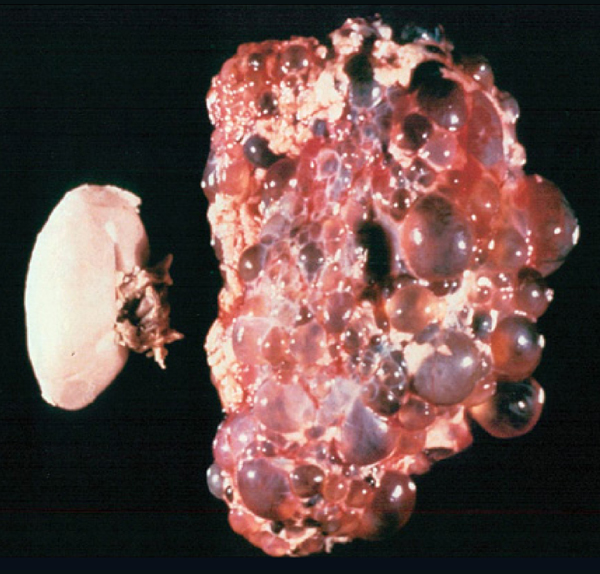
Above is a PG rated visual to introduce you to Polycystic Kidney Disease. The number of sacs can be very numerous, and often they exist on the liver and pancreas as well. As the sacs continue to grow in size, they put pressure on normal kidney tissue, and eventually squeeze the healthy tissue out, causing a deterioration in kidney function. People usually do not experience symptoms until the healthy kidney tissue is compromised. At this time, they may experience high blood pressure, back pain, blood in the urine (hematuria), increased size of the belly, or kidney stones. Eventually the cysts will become so large they will force the kidneys to shut down completely.

At this time, there isn't any treatment that exists to remove or shrink the cysts. If the kidneys are still working, but the person has side effects such as high blood pressure, treatment is focused on managing the blood pressure. If the disease continues to progress to a point where the kidneys are losing function, the person may go on dialysis (hooking up to a machine which will clean the blood in place of the kidneys) or a kidney transplant may be an option. With over 600,000 people in the United States and more worldwide living with Polycystic Kidney Disease, it is hopeful to look at the research being done for treatments.

Below is the R rated visual of PKD:

                                           Copyright Physio-Pedia.com

Citations:

Polycystic Kidney Disease (2014). Retrieved January 7, 2015, from http://www.mayoclinic.org/diseases-conditions/polycystic-kidney-disease/basics/definition/con-20028831?_ga=1.223351000.2110274454.1421215375.

Polycystic Kidney Disease in Social Media. Retrieved January 7, 2015 from http://www.webicina.com/polycystic-kidney-disease/.

Polycystic Kidney Disease. Retrieved January 7, 2015 from http://www.physio-pedia.com/Polycystic_Kidney_Disease.